Affichage des articles dont le libellé est EN- integrated farming. Afficher tous les articles

dimanche 27 mai 2018

131- Agroecology -8- A world without petroleum

AGROECOLOGY - A WORLD WITHOUT PETROLEUM

It will be almost 50 years since the time of the first major oil shock of 1973 that we are told over and over again that the world's oil reserves will be exhausted in 50 years. In 1972, when this serious crisis was looming for a year, the Club of Rome, with the help of a group of MIT researchers, had even planned a depletion of oil reserves twenty years later, in the publication "The limits to growth" https://www.clubofrome.org/report/the-limits-to-growth/
That will definitely happen, that's for sure, although no one is able to predict seriously when that happens. However, one must not be a diviner to understand that a mining resource that is extracted and consumed at this rate, necessarily has a short life expectancy.
That's what will happen at the end of the oil era that interests me today.


Petroleum is the basis of an incredible and very diverse industrial and economic activity, chemistry, pharmacy, agrochemistry, textile, plastics, glues, paints, transports, lubricants, fuels and all their derived products such as paraffin for example. This immense activity will then stop, at least in its present form. Petroleum is today the flagship raw material for all human activity.
Faced with this preponderant place, a huge research activity has been set up, for several decades, to find alternative raw materials for all these activities and productions.

Moreover, the very fertile human genius has already found alternatives for many things. It is often the price, the resistance or the difficulty of supply which makes complex their generalization, as one sees for example for agricultural plastics of vegetable origin. To these technical or economic difficulties, is added the resistance of the current industries which, sometimes, slow as much as they can certain solutions likely to make them competition.
Replacing such a versatile and economical raw material is not easy, especially since oil has shaped, in 150 years, an economic and industrial model whose adaptation is complex.

To put it simply, we can say that petroleum substitutes are oil, cellulose and fibers. These three essential elements to replace petroleum come all from plant and animal production.


The future of humanity therefore passes through agriculture. It's no secret to anyone when it comes to food. But it is likely that few people are aware of it with regard to the chemical industry, textiles, plastics, many modern materials or fuels.
In short, the future of human activities depends on agriculture.


The end of petroleum will profoundly upset the geopolitical balance of the planet, and powerful countries will be those who have been able to preserve their productive capacity in agriculture, whether by preserving agricultural land, by maintaining soil fertility, or the quantity and quality of freshwater resources available for agriculture.

This is where agroecology comes into play, not through the ideologies that are linked to it, but through its development by political choice, and especially by its daily practice by farmers, and in the diversity of its many facets. .
Will major grain countries such as Ukraine still be able to produce as much without a shift to better conservation practices?
Will the frequent refusal to create water reservoirs for ecological or political reasons turn into a serious agroecological problem?


Countries must develop their agricultural potential with a long-term vision, based on conservation agriculture, which can produce a lot while preserving the fundamental resources of biodiversity, soil and water.

Industrial agriculture is not bad in itself. Producing on a large scale has its advantages in terms of quality of structures, compliance with protocols and standards, and investment power, as well as the provision of products. But it must be clearly framed and controlled to avoid the risk of social and environmental drift.

In my opinion, organic farming, in its current forms, will not be able to meet all the needs of humanity in view of the disappearance of the current main raw material.
The current promotion of permaculture as a model to follow and as the future of the world, is more a need to reassure oneself of an intellectual class, mostly favored and urban, largely disconnected from reality, than a farsighted vision of the real needs of humanity and of the planet.
Feeding the world is one thing, but providing it with food, energy and raw materials is another.

The reasonable path to the future is in the middle ground, as is very often the case. And in the case of agriculture, the middle ground lies in an intensive production, but respectful of the environment and the consumer, which does not refuse the chemistry of synthesis by pure dogmatism, but chooses all its production practices for their combination of technical and agronomic advantages on the first hand, and their minimal effects on the environment and health, as well as the saving of resources on the other.

Picture of my own

This agriculture already exists. It is constantly changing, improving day by day, but does not have a real political and social recognition because it does not refuse synthetic chemistry. It is called conservation agriculture for annual cereal and industrial crops, and integrated agriculture for perennial crops and market gardening. But it is not considered politically correct, and finds itself placed by civil society at the same level as industrial agriculture or even the agricultural productivism resulting from the Green Revolution, as it was practiced in the 1960s.
It is totally different, however, and is much closer to organic agriculture than industrial agriculture.
But she has the disadvantage of not to submit to dogma and must be kept quiet.
Guardians of this dogma are in particular the big environmental NGOs, with the support, declared or not, of many personalities of the politics, the spectacle, the cooking and the journalism, and don't accept what they consider as a deviance.
"It's hard to accept the truth when the lies were exactly what you wanted to hear." (Quotation of unknown origin found on Web).

Organic farming retains its place in this agricultural panorama of the post-oil era, to serve a demanding public, rather wealthy, and rather urban. It also remains an important source of evolution and search for new solutions. The fact of never being able to resort to certain solutions obliges to invent, to imagine. Organic farming, in all its forms, is an excellent laboratory of progress.

But agroecology is both a farmer's decision and a political orientation.
Countries that are interested in it, or have already chosen to make it a socio-economic goal, need to make progressive decisions.
Nobody must ever forget that agriculture is not a person.

Agriculture is a whole, a set of people, businesses and interdependent activities, often fragile, that should be changed gradually and with the necessary support so as not to weaken them further.

Countries that will be able to properly prepare for this post-oil era have a bright future ahead of them.

Still, it will be necessary to arrive at this crucial moment with an agriculture in good condition, capable of responding to these new challenges.
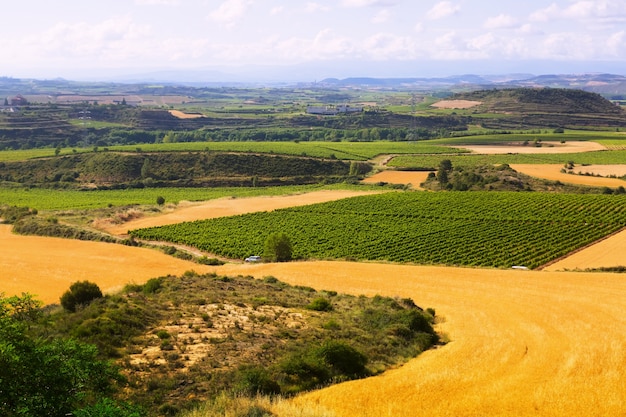
Picture: https://image.freepik.com/photos-libre/paysage-rural-en-ete-la-rioja_1398-4757.jpg

samedi 21 avril 2018

128- Agroecology -7- Agriculture, always greener

AGROECOLOGY - AGRICULTURE, ALWAYS GREENER.


Although the general public, through an incessant media hype, thinks the opposite, the rapprochement of conventional agriculture and organic farming is obvious for those who really care about the issue.

Picture of my own

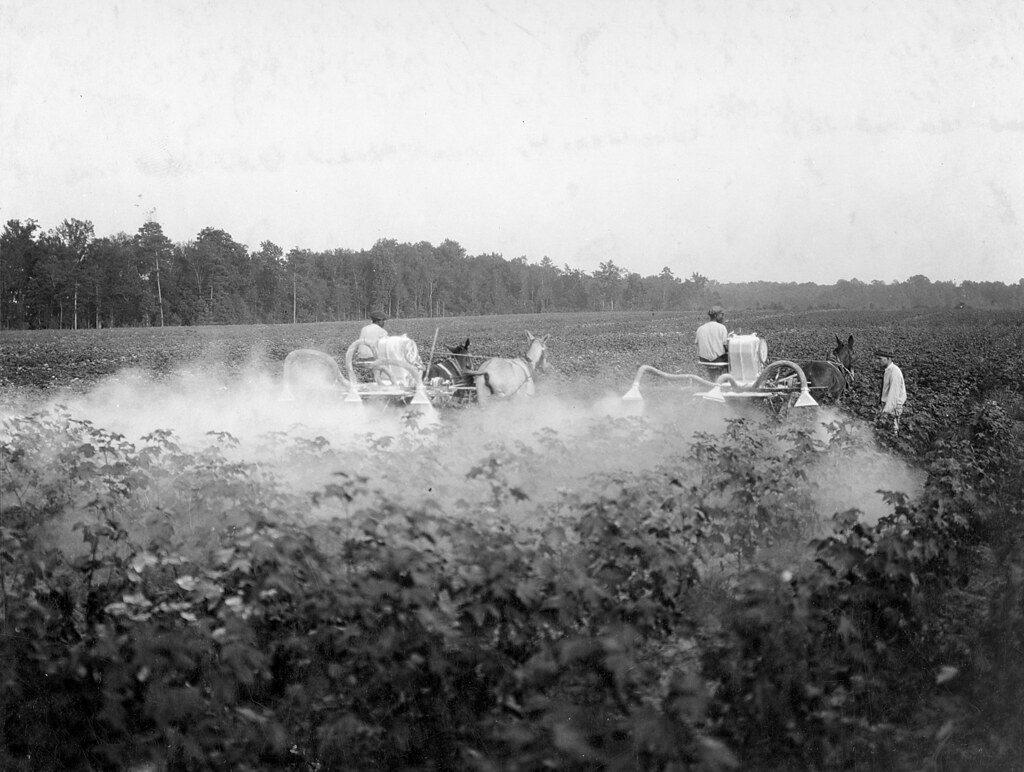
After World War II, Western agriculture abused synthetic chemistry, gradually dragging many developing countries into its wake. It was not a deliberate will of farmers, but rather a conditioning and a strong political will. It was the time of the Green Revolution, full of good intentions and very basic and sometimes mistaken conceptions.
Agriculture was a major driver of economic development. Productivism was the order of the day. It was necessary to feed a population eager for comfort and good food after years of deprivation. It was also necessary to bring in foreign currency, so to export, and agriculture was one of the most obvious axes.
The need for food and foreign exchange was enormous, as was the lack of knowledge of the risks, at least at the level of users (it was the era of the all-powerful DDT, present even in domestic insecticides and in anti-lice lotions for kids, with the blessing of the health administration). To this it should be added that the level of training of farmers was generally very low.


Gradually, research has done (and done well) its work, making many discoveries, always better understanding the functioning of animals and plants, soils and ecosystems, and gradually disclosing this new knowledge.
In short, progress was in progress.

In parallel with these agronomic advances, technologies have progressed at an even faster pace. At the time of DDT, there was no analysis of pesticide residues on food products. These techniques were developed in the 70s, with advances in electronics, and chemistry. DDT has been banned since the early 1970s.
The first residue analysis equipment was able to measure the presence of a molecule in levels of 1 mg/kg (1 ppm) or 1 gram of chemical molecule in 1 ton of food.
At that time, some products might have had pre-harvest deadlines of 0 days. In other words, it was possible to make a chemical treatment, and to harvest fruits or vegetables the same day. And despite everything, analyzes gave absence of residues.
Nowadays, these same equipment are able of determining the presence of a molecule in levels of 1 mg/ton (1 ppb), in other words 1 gram of chemical molecule in 1000 tons of food, that is to say one accuracy level 1000 times higher.
These technological advances have made possible to detect aberrations in authorized uses, and more generally in legislation.
All legislation concerning authorizations and use of chemical pesticides has been accordingly amended.


Meanwhile, medicine has also made great progress, and it has become clear that certain practices or products, known to be harmless, were not so good. Another source of modifications of uses.

At the same time, the research carried out on the environment, and on the impact of these same practices, made it possible to measure their effects, positive, and especially negative.

During the same period, agricultural education has increased considerably, and the level of training of farmers, today is good, at least in the industrialized countries. With this training came the reflection, the reasoning, the integration of agricultural activity in its environment.

Finally, technological progress has also affected information very directly, giving access to all actors in society, to an immense source of information. Unfortunately, the Internet, real revolution in the availability of information, has also become a gigantic forum in which anyone can say anything, without giving proof of what he says, while receiving a large audience.

All these advances, made in parallel, but without consultation with each other, have led to many changes in legislation, in concerns, in behavior.

However, despite all the problems detected a posteriori thanks to technological and scientific developments, despite the proven toxicity of certain products in common use, life expectancy has steadily increased in the industrialized countries. The quality and diversity of available food counterbalanced the problems caused. This does not mean that we should not change anything, on the contrary. But we have to relativize the seriousness of certain problems.
It must also be remembered, particularly with regard to soil and groundwater pollution, that we continue to pay, even today, the consequences of certain decades-old mistakes. Thus, some soils still contain DDT residues, more than 40 years after its prohibition, but decomposed as DDD and DDE. It will take several more decades to disappear.
This is why current assessments are so strict, especially concerning the degradation of new molecules in soils and water.


Going back to the subject of the day, all these changes have had a series of important consequences on agriculture:
-       Farmers are currently well trained and concerned about their health, the health of consumers and their environment.
-       Ecological movements have developed strongly and, by their often questionable action, have largely participated in this awareness, now widespread throughout society.
-       Governments have taken the measure of the problem and have legislated, both on authorizations of chemicals, and control of their use.
-       The number of authorized molecules has been drastically reduced, with the elimination of all the most dangerous products, and the authorized residue levels have all been sharply revised downwards. Currently, European legislation is the most restrictive in the world by far.
-       Chemical companies have radically changed their research orientations, in order to respond to these evolutions, with the result of the apparition of products that are ever more respectful of the environment, the user and the consumer. Even the biggest chemistry companies have started looking for organic products.
-       Most conventional farmers are integrating into their methods and production techniques, elements, always more numerous, compatible with organic farming.
-       Some points remain unresolved, in particular measures of the real impact of non-chemical pesticides, authorized in organic farming, on the environment, on the user and on the consumer. This is where the media pressure does not work well.


In fact, if we look closely, we realize that conventional agriculture has largely evolved towards an integrated production for woody crops (fruit production, vine, olive, citrus, etc.) and for many annual crops, such as horticulture. For other crops (cereals, cotton, forages, etc.), conservation agriculture goes in the same direction. These two methods and their variants have incorporated in cultivation practices, many more environmentally friendly techniques, have reduced the use of pesticides and fertilizers, the doses and times of application have been greatly improved thanks to the knowledge gained on the biology of crops, soils and the environment. See for example http://culturagriculture.blogspot.com.es/2014/11/32-farming-methods-4-integrated-farming.html

At the same time, organic farming has also evolved, especially with the arrival of new solutions to the health and nutritional problems of crops. It must be said that there is a great deal of public and private research on plant protection techniques and non-chemical pesticides.

Crop protection remains a major challenge for farmers, regardless of the production method. It must be recognized that the profitability of the crop remains the first concern for the farmer who is, above all, a business leader, whose activity must not only be profitable, but in addition it must allow him to generate sufficient income for himself in order to live worthily his family.

Picture of my own

In fact the rapprochement between these two great currents is rapid, and inescapable. I don't believe that we are coming to a fusion, because organic farming refuses certain orientations, such as biotechnologies, although they are undoubtedly the most direct and rapid way towards a disappearance of pesticide needs, be they chemical, or non-chemical.

The organic tends to stagnate in the evolution of its techniques (except on the phytosanitary protection), keeps many zones of shadows (especially in its communication), and survives with many currently insoluble problems, by accepting sometimes the use of certain synthetic pesticides, under controlled conditions. Public aid, much more important in organic than in conventional, also contributes to its development. But it is industrializing by necessity, to meet the needs of a market increasingly dominated by supermarkets.
Conventional is reforming in depth, is becoming every day a little more respectful of the environment, soil, groundwater, consumers, in short, is becoming greener and greener.
The consumer, so courted by everyone, and largely intoxicated by a politically correct and carefully orchestrated disinformation, will eventually get lost. There are signs that it's increasingly difficult to tell the difference.

And not everybody likes that.
Who among the many profiteers of organic, really wants that organic farming takes a large scale? Who wants this rapprochement and the virtual disappearance of differences?
It would be the death of the golden goose.
Would not this be one of the main causes of the ever more numerous and virulent attacks against conventional agriculture?
Who knows?

It is a short-term vision, capitalist, pure economic management but in the meantime, the benefits will be better, whether economic or political.

If particular and political interests do not take precedence over the public interest, one should actually witness a collaboration between the two tendencies. Yet, in reality, there is a clash.

So, dare I say, who benefits from the crime?
Neither the farmer nor the consumer, anyway.

Picture: http://www.mes-ballades.com/77/image-77/77_FAUNE_combat-de-cerfs-faune.jpg

dimanche 18 juin 2017

107- Natural vs synthetic -5- Pheromones

NATURAL VS SYNTHETIC - PHEROMONES

In the late 1980s, I was a young fruit production advisor in the South-East of France for a specialized technical group, the GRCETA of Basse Durance.
After the group was contacted by an Australian company, I had the opportunity to participate in the first trials to test on a large scale the protection against oriental fruit moth (one of the most dangerous pests in this area) by pheromones, with the technique called sexual confusion. This Australian company was trying to test its diffuser and its pheromone under conditions of high pressure of the pest. Logically, it wanted to do it in the region internationally known as the most problematic one.


You have to know that at that time, the oriental fruit moth turned into a real nightmare for peach growers in the region. The pest populations were extremely high. There were some problems with the loss of efficiency of the usual insecticides, forcing farmers to do frequent pesticide interventions with insufficient levels of efficiency, hence both technical and economic problems. At the time, there was virtually no mention of the environmental consequences, but from the current perspective, it is scary...

The fact is that this Australian company came up with this innovative technique, plunging us into an abyss of reflection, and doubt.
Imagine thirty years ago, the proposal to solve a critical problem of insects without insecticides. For us, advisers, in whom the farmers of the group sometimes blindly confided to help them to solve their problems, it seemed insane. We were very motivated by the innovation, but sincerely, given the seriousness of the situation in some areas, we were also very suspicious.
The experimental zone was chosen in a concrete area of ​​Provence which was in such a critical situation with regard to the oriental fruit moth that some farmers began to consider a conversion of crops when faced with the impossibility of controlling the damage.


After a whole season of experiments, the farmers' surprise at the results was pleasing to see. Without being wonderful, they were superior, without insecticide, to the enhanced program that they needed to implement, and that included more than 15 chemical sprayings.
After two years of testing, the conclusion was that to resolve a much degraded situation, it was necessary to go through a first phase that combines chemical protection with sexual confusion, enough time to reduce the level of infestation (1 to 2 years). From this moment, confusion alone is enough to avoid the damage.
At that time, as a technician participating in the tests, I always had a number of diffusers in my car in order to be able to replace one, or to complete a dose in a difficult place. The consequence?
I was pursued every day, both in the car and outside, by a wild horde of oriental fruit moth males, persuaded that I was the princess of their dreams...


Pheromones are natural substances, emitted by living organisms to transmit information to their conspecifics.
Their role is well known in most animals, and in some plants.

These are generally volatile compounds, produced by exocrine glands. Unlike hormones designed to be used internally by the body, pheromones are produced to be released outside the body to transmit a message or signal to individuals of the same species. Their role in the sexual reproduction of insects is well known and has been the subject of numerous studies.
It is thanks to sexual pheromones that, for example, Lepidoptera (butterflies) male are able to locate females, allowing them to mate and continuity of the species.
Each insect has its own "aromatic bouquet" in order to attract individuals only from its own species.
In addition, pheromones have different types of roles such as sexual attraction, alarm, aggregation, territoriality, and exist in almost all animals, even in humans. Bees use them to indicate flowering areas, ants to mark their paths, dogs and cats to mark their territory, humans in situations of fear or sexual desire for example.
They can also be found in products designed to calm or repel dogs or cats, or even to make you irresistible in a night club.


The principle of the technique of sexual confusion is thus the following one.
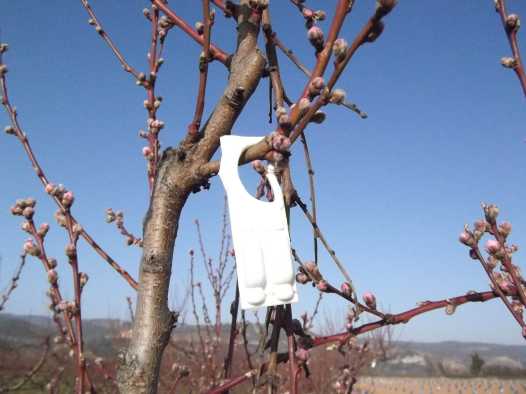
The pheromone contained in the diffuser is the same as that emitted by the oriental fruit moth female so that the male is able to find it, and thus can mate. The diffuser is made of a porous plastic which allows a progressive diffusion of the pheromone for several weeks.
In nature, a female emits the pheromone that is carried by the air. The male receives this olfactory message through a specific receiver and follows the trail until it finds the female.


The technique of sexual confusion consists in distributing a large number of diffusers in the cultivated plots. In this way, the points of emission are so numerous that the male is practically unable of finding the female.
The mating is disturbed, the reproduction does not take place, so the insect is no longer a problem for the farmer.

Traditional protection involves killing existing insect pests to prevent them from breeding and causing crop damage.
Sexual confusion means preventing insect pests from being able to reproduce. They are therefore not present in the crop and don't cause damage.
This is a profound change in the concept of crop protection. It is a technique of prevention of the damage.

So we have a technique that works well, and that avoids the application of chemicals on the crop. It should be noted that pheromones are used in agriculture in at least 3 different techniques:
Sexual confusion, which consists in diffusing a very large quantity per hectare, so as to disturb the males in their system of approximation of the females, drastically reducing the possibilities of mating and therefore of reproduction. Pest populations decline "naturally", and consequently, damage to crops.
Monitoring trapping, which consists of placing a few pheromone traps on the farm, in order to capture individuals and to monitor populations (beginning of flights, peaks of flights, time of hatching and risks). This technique, the first historically speaking, to use pheromones, makes possible to locate with a great accuracy the exact moment of intervention with insecticides, synthetic or natural. That was one of the foundations of Integrated Production.


Mass trapping, which consists of placing traps with a large quantity of pheromones, in a reduced number per hectare, in order to capture a large number of individuals, thus reducing the pest population without applying pesticides. This technique is much used with food attractants, more than with pheromones.

The technique of sexual confusion has developed considerably and is now used to protect crops, especially in vineyards and orchards, against mainly lepidoptera, diptera, hymenoptera and beetles.
Obviously, the technique was very quickly authorized in organic farming. It is logical, a technique that allows effective protection without using pesticides, neither synthetic nor even natural, deserves attention.

But in fact, these pheromones, freed in large quantities and permanently, where do they come from?
No, there are no swarms of worker pressing on the abdomen of billions of female butterflies to draw a microdrop of pheromone each time.
It is chemistry, pure and hard.
These pheromones are synthetic, precise copies of natural ones, derived from chemistry, naughty chemistry.
They are then enclosed in plastic diffusers, also derived from the naughty chemistry.

But can these synthetic chemicals, released into the air from crops, reach the food?
Without any doubt. My personal experience of the 1980s has amply demonstrated that these pheromones are deposited on everything around them. Otherwise, I would not have been pursued by all these confused and excited males!
Their effect is fleeting, it is true, but the reality is there.

So, would organic agriculture allow large-scale use of synthetic chemicals that come into direct and permanent contact with food?
Well yes, absolutely.


However, the gravity of the case must be put into perspective. These are synthetic products, yes, but they are exact copies of natural molecules.

As in the case of azadirachtin, right?
For azadirachtin (and you will soon see that this is not a unique case), the copy of the natural product is refused because it is synthetic and therefore incompatible with the ideology of the organic, despite all the technical and environmental advantages in relation to the extraction and use of the original natural substance.

Except that this prohibition of principle, questionable in itself, but consistent with organic ideology, is not always applied. There are situations where a breach of the rules is possible.

Note that the consumer of organic products, ultimately the engine of the system, is not aware of these changes in the rules of the game.
The information it receives remains the same. No chemistry in organic production.
But what would he say, the organic consumer, convinced that there is no chemistry in the organic production, and that he really takes care of his health and the planet, if he learns that they lie to him every day, that he is jobbed by those same people in whom it has placed its confidence?

Is this a double standard?

It must be recognized that agriculture is not easy, and that crops must be well protected from diseases and pests, even in the case of organic products. And if there is no organic solution, we will find one, almost organic. We should not lose the market.
This is not sexual confusion, it is intellectual confusion.

Picture: http://www.vitisphere.com/upload/breves/1442481694_g1.jpg

lundi 24 avril 2017

104- Natural vs synthetic -4- About the production of natural pyrethrins

NATURAL VS SYNTHETIC – ABOUT THE PRODUCTION OF NATURAL PYRETHRINS

Following my previous article in this series on pyrethrins and pyrethroids (https://culturagriculture.blogspot.com.es/2017/04/101-natural-vs-synthetic-3-pyrethrins.html), I received a question, on April 5, on the French version "Hello, to produce natural pyrethrins, it is advisable to grow flowers of pyrethras. More and more pyrethras, since there is more and more organic farming. Do you know if the cultivation of these pyrethrum flowers is done in organic farming? "
My answer was "I dare not even think that pyrethrum fields for the production of organic pesticides can be grown with synthetic pesticides. But, is there any control? I don't know. "


But Wackes Seppi, known to the francophone agricultural community for his blog (http://seppi.over-blog.com/) abundantly provided and critical, gives me a link in French (https://erwanseznec.wordpress.com/2016/10/12/comment-le-bio-externalise-les-pesticides-conventionnels-chez-les-pauvres-121016/), with the comment "You will fall on your ass! "

And I fell on my ass!!!

Erwan Seznec is a freelance French journalist, known for his critical stances, often going against social and political correctness.
In October 2016, he published on his blog the following article, which I reproduce in full, as usual.


"How organic outsources conventional pesticides to poor countries- 12/10/16

The tidal wave of articles announcing the disappearance of pesticides in private gardens by 2019 has opportunely covered two rather inconvenient conceptual pitfalls. The first one, developed in the organic pesticides survey published in Que Choisir [a French review and association of consumers], is that organic pesticides, which will remain allowed, are not really free of inconvenient. Furthermore, these organic pesticides don't eliminate the use of conventional pesticides. In the case of pyrethrin, they outsource it in East Africa and Papua New Guinea.

Pyrethrins are insecticides produced from Dalmatian pyrethrum and chrysanthemums flowers. They are found in dozens of preparations, authorized in organic farming.

The flowers in question, of course, must be grown somewhere. In this case, Tanzania (60% of world production), Papua New Guinea and Kenya. We learn from this Kenyan document that it takes 52,000 plants to obtain 25kg of powder. Here, it is discovered that pyrethrum, unsurprisingly, is attacked by pests and fungi.

And in this very detailed Australian study (1), the perceptive reader finds confirmation of what common sense may already have suggested. To spray these non-food crops, Tanzanians and New Guineans growers have no reason to use organic, more expensive pesticides. They use the conventional arsenal.


"In pyrethrum crops in East Africa and Papua New Guinea," the Australian and American researchers wrote, "fungicides effective against chrysanthemum ascochytosis include ethylene bis-dithiocarbamates, captan, benomyl, chlorothalonil and dichloronaphthoquinone". Moreover, "a range of other products belonging to the group of demethylation inhibitors, including difenoconazole, have proved their efficacy", provided that they have "several applications of these fungicides".

Difenoconazole is almost all that is prohibited by organic agriculture: toxic to mammals, to aquatic environments, and persisting with a half-life of 1600 days under certain conditions. It is page 5 of the study (1).

In the two years after the efficacy tests, researchers praise, "90% of the pyrethrum producers in Tanzania" have adopted the fungicide program. The Australian authors are from the University of Tasmania, where pyrethrum is also grown. One might think they have good information about Africa. MGK, the Australian sector leader, has farms in Tanzania.

In 2010, German researchers pointed out the paradox. Kenya produces dried pyrethrum flowers, but "95% of the raw pyrethrin is exported to more environmentally-conscious developed countries, where it is sold at premium prices, leaving Kenya to import cheaper synthetic pesticides." (2).

The Kenyan case suggests that the cultivation of pyrethrum is not an easy task. From 70% of the world market in the early 2000s, its production fell to less than 5% ten years later, due to irregularities in yields. Agriculture is an exciting but difficult trade.

Erwan Seznec

1) Diseases of Pyrethrum in Tasmania: Challenges and Prospects for Management. http://apsjournals.apsnet.org/doi/pdf/10.1094/PDIS-92-9-1260  

2) « Incidentally, Kenya is the leading producer of a natural pesticide, pyrethrin, which is a broad-spectrum insecticide made from dried flowers of pyrethrum (Chrysanthemum cinerariaefolium). However, 95% of the crude pyrethrin is exported to more environmentally conscious developed countries, where it earns a premium price, leaving Kenya to import the cheaper toxic synthetic pesticides ».  Potential environmental impacts of pesticides use in the vegetable sub-sector in Kenya. »

I will add, because it seems important to me, that the Australian document also explains, on page 2, that for a successful pyrethrum crop, the use of herbicides is necessary, as well as intensive sprinkler irrigation with use of fertilizers. It is finally learned that the harvest of flowers is mechanical.
All these criteria are a priori contrary to the philosophy of organic farming.


My surprise was such that I decided to look a little more. And I came across a Kenyan document from HighChem Agriculture, a consulting and support company for pyrethrum producers, also selling seeds and crops. This document explains main stages of cultivation (http://www.highchemagriculture.co.ke/en/pyrethrum-farming.php) and shows that pest control is based on 3 synthetic insecticides, carbaryl (a carbamate banned in Europe since 2006), dioxathion (an organophosphorus banned in Europe since 2002) and, surprisingly, alphacypermethrin, a synthetic pyrethroid.
And all this to produce a natural pyrethrin, authorized in organic farming?

Her we are.
What do we have to think?
What I have already told you several times: organic is above all a juicy market, for which everything is allowed, especially cheating cheerfully the consumer, but also the farmer (who in this case buys natural pyrethrins in good faith, without knowing that he is fooled).
This market is primarily developed in the richest countries (especially in Europe), in which it is fashionable, it is even the most perfect chic to consume organic. It's better for the planet!
Yes, except that, on the one hand, the organic has many dark sides that are systematically ignored, and on the other hand, making organic in Europe is much easier if we the most negative aspects are relocated to the other side of the planet!

We are once again in marketing, in communication.
We ignore all non-seller aspects, not to shock the consumer. It is the same problem with GMOs. It is hardly produced in Europe, but it is imported by whole boats produced in other parts of the world.

It's the same thing. Contrary to what I believed, candid and naive, organic pesticides are not produced according to the essential criteria of organic farming.

It's simply unbelievable!!!

This does not detract from the merit of farmers who produce organic, whether by philosophical or economic choice. But they have to do it with a limited number of alternatives to solve phytosanitary problems, that they will have anyway, and which requires them to work extremely precisely because they have very little margin for error.

But it just shows that, ultimately, organic farming is a huge fraud, which is used to the benefit of a few people, on the back of farmers and consumers.

I have already told you, I repeat it once again, and it won't be the last time, the future is not Organic Farming, it is Integrated Farming (https://culturagriculture.blogspot.com.es/2014/11/32-farming-methods-4-integrated-farming.html), or more recently Agroecology. In short, the use of pesticides is essential for sustainable agriculture, and a fairer and more ecological food production.

Will our politicians be smart, well-advised, honest and courageous to tell to environmental lobbies, as well as to industrial lobbies, that their place is not in the political debate?