ORGANIC
PEACHES, REALLY?
The
peach, it's been a long time since I fell into it. This is in my opinion, among
crops I know, one of the most difficult and the most technically interesting.
No mechanization is possible, or almost, everything is still craft and manual,
even on a large scale. It's one of the last "social" crops in
industrialized countries, that is to say that generates a large number of jobs
for non-specialized people.

Personal
picture
If
you follow my blog for a long time, you know that I am not an advocate of
organic, because I totally oppose the marketing line on which it's based for
more than 30 years. Organic production has many qualities, but also some
defects, some of them serious. Yet, all marketing is done, not on the basis of
a valuation of organic, but on the basis of attacks against non-organic. The
fear of poisoning is branded as a weapon of mass destruction, without looking
at the collateral damage, everyday more numerous and serious. But there is no
justification for that, quite the contrary. Look at cases of food-borne
mortalities in the last quarter of a century. The only serious cases systematically
involve food produced in organic (E.coli on sprouted seeds, salmonellosis on
melon, botulism, etc.). No similar cases demonstrated exist on conventional
foods.
Should
we ban organic? Of course not. But it must be controlled at least as well as
the conventional, which is not currently the case. The new European regulation
goes in this direction, fortunately (http://culturagriculture.blogspot.com.es/2017/11/119-reforming-organic-is-not-so-natural.html).
You
also know that, without doing organic production, I don't criticize organic
farmers, and I often write about ecological or agroecological problems.
In
fact, I am often asked why I don't do organic farming.
And
that's exactly what I want to talk about today.
I
don't own the land I grow. I manage the production for a private company. As
such, I don't always have my hands free.
Yet,
I know that, commercially speaking, it would be interesting to do organic.
But
I don't do it.
Today,
it's practically impossible to produce organic peach.
A
clarification for those who don't know it: when I talk about peach, I'm talking
about all subspecies or denominations that are included in the species Peach Prunus
persica, ie peach, nectarine, (hard-flesh peaches for canning), flat peach
(paraguayo), platerine (flat nectarine), as well as white, yellow or blood
flesh. It's the same species, it's almost impossible to distinguish the tree
from one subspecies or another and cultivation conditions are the same.

Picture: http://legacy.justrivals.com/s3/justrivals-webassets/rivalries/peaches-vs-nectarines-17534.jpg
I
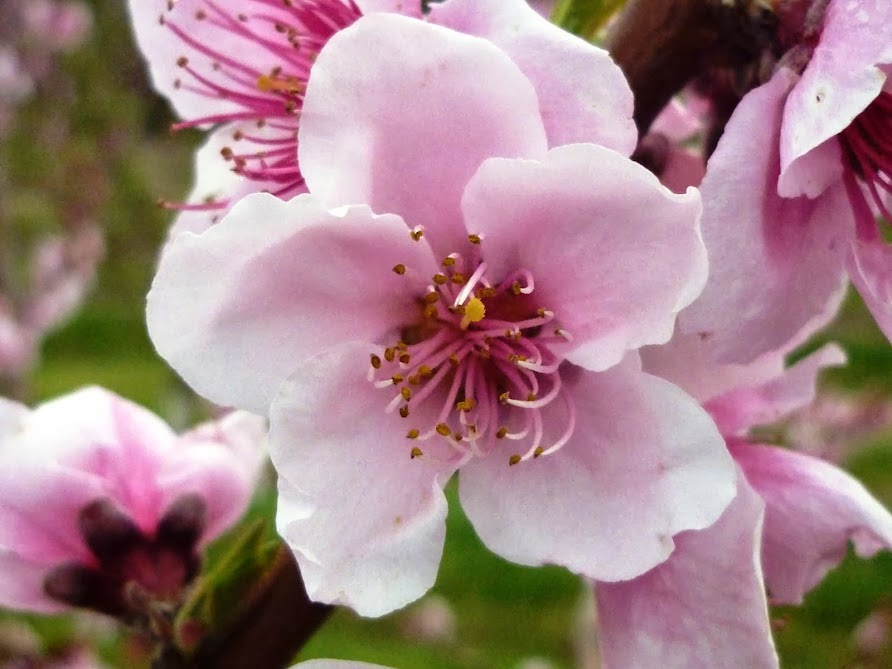
told you that organic is almost impossible for peach. Let's clear that. I can
have three peach trees in my garden, no spray them and eat peaches all the
same.
There,
I ask a question to those who have some peach in their garden and who eat the
peaches with the more pleasure they come from their garden. These few peaches,
as they are when you pick them, would you buy them in a store?
The
answer will be no for most, as these fruits are usually deformed, stung,
stained, small and ugly. However, fruits as damaged, even organic, are not able
to be sold (http://culturagriculture.blogspot.com.es/2017/08/112-quality-5-when-organic-gets-going.html).
The
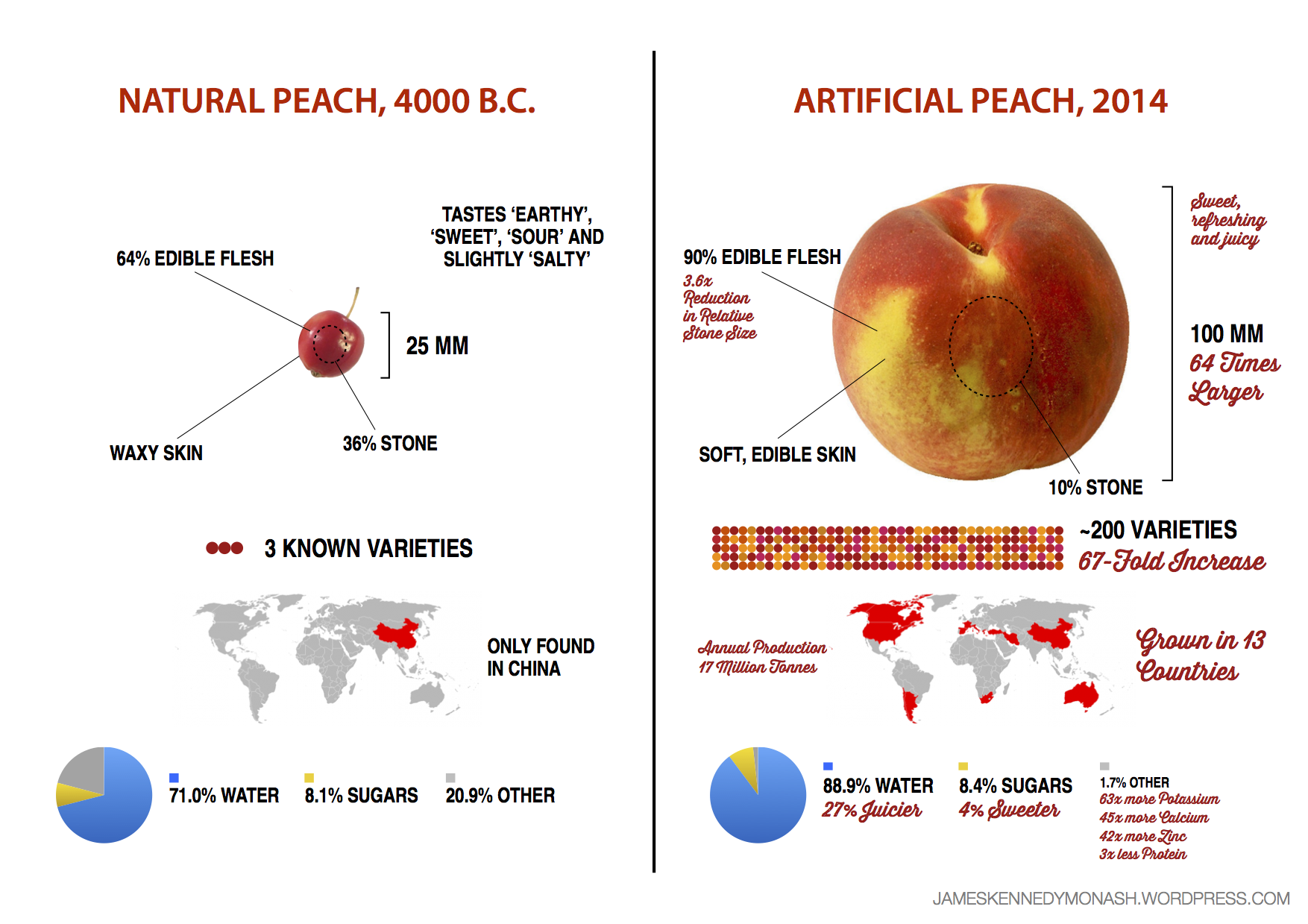
peach tree is highly susceptible to an important number of diseases and pests,
capable of almost completely destroying the crop.
In natural
conditions, tree produces small fruits and few. But the variety selection
carried out for several centuries has sorted the characters of size, aesthetics
and flavor, in general without combining them with criteria of rusticity (which
is frequently the case for most plant species). In the cultivated peach, we
don't find old rustic varieties, known locally but with characteristics not adapted
to market needs, as is the case, for example with apple tree or plum tree, and
which could serve as a natural genetic source of resistance.
Research or
experimentation centers specialized in organic farming, very aware of the
problem that everyone faces for the serious development of organic fishing, are
reduced to empirically test the behavior of ancient or modern varieties. (Http://www.grab.fr/wp-content/uploads/2014/07/A12RA02SensibiliteVarietalePechers.pdf).
It is an
extremely long and expensive process, which gives very poor results.
And the
production of organic peaches does not take off. There are some crazy people to
do a little, but always on a very small scale, for a short and confidential
market, and with immense economic risks.
Since the
takeoff of organic and the explosion of consumer concern for health and
environment, botanists around the world have not had all the freedom to go prospecting
in origin regions of peach tree, China and Persia, and more specifically Iran
and Afghanistan, plagued by political tension and incessant conflicts for 40
years. There are "forests" of wild fruit trees, from natural chance
crossings and centuries of adaptation, and there is therefore a huge genetic
diversity. These surveys, usual in botany, allow a real work of genetic
improvement within the same species, without the need to look for genes in
different plant species.
I
don't doubt that the day will come when scientists will have developed
varieties really resistant to these diseases and pests currently very
dangerous.
But in the
current genetic situation, peach remains a globally non-culturable species in
organic. I'm not saying that you are not going to find a small organic peach
grower, in a village market, who sales some organic peaches from his meager
production.
But if on
the contrary you find beautiful peaches, big and in quantities, then beware.
They may be
free of pesticide residues. But making a fruit without measurable residues of
synthetic pesticides (the so-called zero residue), has nothing to do with
organic production, because synthetic pesticides could very well have been used
throughout the vegetative cycle without leaving a trace.
So organic
peach today, means very small production, usually unprofitable for the farmer
(with very high risk in production), and sold at a high price, or frequent
deception from the farmer, and from the distribution channel. For example, be
suspicious if you find organic peaches in a supermarket. The structure of peach
organic production and the volumes produced don't meet the requirements of this
type of marketing.
When you
read all these articles that claim "bio could feed the world", just
know that you are being manipulated. The future will undoubtedly be very
different, but currently, organic production can’t feed the world, for the
simple reason that many problems currently have no solution in organic. Today,
organic can feed a certain world, rather Western and wealthy. Organic eating
today is the privilege of a few. The poor and developing countries are content
to hope they can feed themselves.
It's
true that progress in this direction is made daily, but for the moment at
least, synthetic pesticides are still essential for a large part of
agriculture.
But see the
case of the peach, which is not at all a unique case. The natural hardiness of
the species is low. Genetic work on natural resistance is in its infancy, and
will only succeed, if it succeeds, in several decades. The only solution, in
the current state of knowledge, to maintain a production which allows the
farmer to live from his production, by obtaining fruits in reasonable quantity
having a qualitative standard sufficient for the market and the satisfaction of
the consumers, is the use of pesticides.
To make
organic, it will of course be natural pesticides, or in any case accepted by
the organic specifications.
And again,
we are facing a problem. Some diseases (rust, blisters, conservation diseases)
and pests (green aphid) don't currently have an effective organic solution.
Of
course, what is true today will not be true in a while, and research is
progressing rapidly.

Picture: http://www.atlantico.fr/sites/atlantico.fr/files/styles/une/public/images/2015/02/moisissure.jpg
But to affirm today that organic
could feed the world is a scam.
It's just
letting consumers believe that farmers, marketers, and governing authorities
take pleasure in allowing and using pesticides that are supposedly useless,
just to be able to pollute the planet and take risks for users and consumers
health.
It also
suggesting that a quick and complete conversion could be achieved, while it's
very far from being the case.
It is
overlooking that in many cases, organic is currently profitable only because it
benefits from specific aids, and especially a high price differential, which
will disappear on its own when organic is the norm, causing an inevitable
explosion in consumer prices, or the ruin of farmers.
It's also
affirming that developing countries, where farmers often don't have access to
pesticides, are the only ones responsible, because of their lack of knowledge,
of their own poverty and their famine deaths.
It's also
forgetting that what currently feeds city dwellers in their vast majority, is a
healthy and diversified food, whose sanitary quality has never been so high,
resulting from an efficient agriculture, very mechanized, sometimes industrial,
and that changing it for organic will not be easy.
It
is also ignoring that if the world converts to organic, it will be necessary to
increase the cultivated area, deforest, use more fresh water for food
production, more arable land for the production of natural pesticides or
fertilizers, and therefore reduce areas of biodiversity. Even the most recent
and serious studies overlook this "small" detail (https://www.nature.com/articles/s41467-017-01410-w).
And to say
that a large part of the solution involves reducing food waste is totally
illusory. This is called wishful thinking. It's true, it's beautiful, it's
well-thought, it does not cost anything to say, but it has almost no chance of
success.
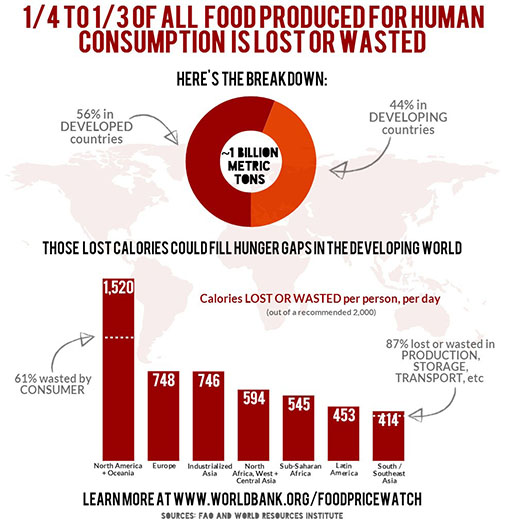
Because it's
to forget that almost half of the food waste comes from poor countries where
the lack of training, the lack of mechanization, the lack of availability of
pesticides, the lack of transport means and the lack of conservation means are
responsible of the majority of losses included in this "waste".
It also
forget the fact that most of the waste in rich countries comes from the
aesthetic requirements of the market and poor lifestyle shopping habits, which
make a significant part of this waste occur between buying and the timing of
consumption, directly at the household level. http://culturagriculture.blogspot.com.es/2014/01/v-behaviorurldefaultvmlo_10.html
And
it will not be easy to change at all. The development of poor countries will
not be done in a few years, and the modernization of their agriculture will
inevitably lead to the same evolution as those of the developed countries. That
is to say that the waste will not be reduced almost, it will change in nature.
On the other
hand, to affirm that in a few decades (and remaining very vague on the
deadline), organic could feed the world, I agree. The market is juicy, the
concern of consumers is growing day by day, and it's obvious that this path has
a great future, because it's one in which research is the most dynamic, and the
most subsidized. Political and economic aid makes things highly easier. I am
not very sure that we will find natural solutions to all problems. I remain
personally convinced that the future is not for organic production, but for
integrated production.
Now, let's
be clear, the day that organic will feed the world, then it will become the
food standard. This means that there will be no more price differential, no
subsidies, no conversion aids. This also means that a large part of the farmers
will have disappeared in rich countries, to the benefit of farmers able to
produce cheaper in poor countries, or consumer prices will have risen in an
explosive way.
But I don't
believe that political authorities will let this situation settle, which would
be a negative economic revolution that would seriously affect household
consumption, and therefore countries’ economies.
And we will
stay at the first hypothesis. Most of the food will then come from poor
countries, which will remain competitive despite high transportation costs
(both economic and ecological levels).
We
will produce organic, and we will continue to pollute as much as now, if not
more.

Personal
picture
We must also
see that the giants of agro chemistry have already felt the wind turn. They
have taken the lead. All, without exception (Bayer-Monsanto,
ChemChina-Syngenta, Dow-Dupont, BASF and others) are investing, or have already
done so, in locations or buy-outs of companies or laboratories, specialized in
the research for biological phytosanitary solutions. They started to offer organic
solutions to many crop problems.
In fact, if
the future is probably organic, it's probably not in the reduction of
pesticides, on the contrary. We will continue to spray crops as much, if not
more than currently, everything will depend on the duration ability of these
new organic solutions. Simply, synthetic pesticides will be substituted by
pesticides accepted in organic.
And I'm
willing to bet that we will again have some pretty scandals around this or that
organic pesticide which we will have discovered that it pollutes tablecloths,
soils, that it's an endocrine disruptor or that one finds it in children's
hair.
You see, all
hope is not lost, there will still be enough to feed environmental NGOs or
citizen movements, even when the world will be organic.
This is because organic does not
always mean healthy and environmentally friendly.
But when the
little manipulable people will understand that, I really wonder how the
situation of Western agriculture will be.
But we must
recognize that farmers currently converted to organic (and a priori excellent
professionals, it's not to denigrate) will then have a clear head start in
terms of cost management in organic farming, which will be absolutely
fundamental to the survival of farms.
And the quality in all this?
The what?

Personal
picture