Affichage des articles dont le libellé est EN- organic matter. Afficher tous les articles

mercredi 25 octobre 2017

117- The soil -4- Make our soils great again

MAKE OUR SOIL GREAT AGAIN

It appears increasingly clear that agricultural soils are a resource wrongly apprehended by past generations of farmers, and ultimately unintentionally, or rather unconsciously damaged.


The Green Revolution, with its good intentions, has solved many of the food security problems in the world, at least at the level of production.
But its reductive vision, and the excessive proportion of inputs (pesticides and fertilizers), and the spectacular improvement of productivity that followed in the first years, have made that most of farmers forgot some foundations of our great activity.
The awakening is brutal, with sometimes dramatic findings, terrible erosion problems in some places, soils that have sometimes lost their structure, a soil reduced or destroyed soil life, a microbial activity at half-mast, in short, fertility losses that become compelling under certain conditions.

But nothing is lost, most mistakes are recoverable, and the oldest experiences of changing farming practices show that it's always possible to go back and combine productivity needs with respect for ecosystems, and especially the recovery of our soils.

I propose this text, published in spring by David R. Montgomery, in the British edition of the digital magazine The Conversation, under the title (parody of the slogan of Donald Trump during his election campaign) "Make our soil great again".


Make our soils great again

By David R. Montgomery
Professor of Earth and Space Sciences, University of Washington


“Most of us don’t think much about soil, let alone its health. But as Earth Day approaches, it’s time to recommend some skin care for Mother Nature.
Restoring soil fertility is one of humanity’s best options for making progress on three daunting challenges: feeding everyone, weathering climate change and conserving biodiversity.

Widespread mechanization and adoption of chemical fertilizers and pesticides revolutionized agriculture. But it took a hidden toll on the soil. Farmers around the world have already degraded and abandoned one-third of the world’s cropland. In the United States, our soils have already lost about half of the organic matter content that helped make them fertile.

What is at stake if we don’t reverse this trend? Impoverished trouble spots like Syria, Libya and Iraq are among the societies living with a legacy of degraded soil. And if the world keeps losing productive farmland, it will only make it harder to feed a growing global population.

But it is possible to restore soil fertility, as I learned traveling the world to meet farmers who had adopted regenerative practices on large commercial and small subsistence farms while researching my new book, Growing A Revolution: Bringing Our Soil Back to Life. From Pennsylvania to the Dakotas and from Africa to Latin America, I saw compelling evidence of how a new way of farming can restore health to the soil, and do so remarkably fast.

Workshop on cover crops, weed management and no-till practices at the Stark Ranch in Gainesville, Texas.


These farmers adopted practices that cultivate beneficial soil life. They stopped plowing and minimized ground disturbance. They planted cover crops, especially legumes, as well as commercial crops. And they didn’t just plant the same thing over and over again. Instead they planted a greater diversity of crops in more complex rotations. Combining these techniques cultivates a diversity of beneficial microbial and soil life that enhances nutrient cycling, increases soil organic matter, and improves soil structure and thereby reduces erosive runoff.

Farmers who implemented all three techniques began regenerating fertile soil and after several years ended up with more money in their pocket. Crop yields and soil organic matter increased while their fuel, fertilizer, and pesticide use fell. Their fields consistently had more pollinators — butterflies and bees — than neighboring conventional farms. Using less insecticide and retaining native plants around their fields translated into more predatory species that managed insect pests.

Innovative ranchers likewise showed me methods that left their soil better off. Cows on their farms grazed the way buffalo once did, concentrating in a small area for a short period followed by a long recovery time. This pattern stimulates plants to push sugary substances out of their roots. And this feeds soil life that in return provides the plants with things like growth-promoting hormones and mineral nutrients. Letting cows graze also builds soil organic matter by dispersing manure across the land, rather than concentrating it in feedlot sewage lagoons.


Soil organic matter is the foundation of the soil food web, and the consensus among scientists I talked with was that soil organic matter is the single best indicator of soil health. How much carbon could the world’s farmers and ranchers park underground through soil building practices that incorporate plant residue and stimulate microbial activity? Estimates vary widely, but farmers I visited had more than doubled the carbon content of their soil over a decade or two. If farmers around the world did this, it could help partially offset fossil fuel emissions for decades to come.

Soil restoration will not solve world hunger, stop climate change, or prevent further loss of biodiversity. No single thing can solve these problems. But the innovative farmers I met showed me that adopting the full suite of conservation agriculture practices can provide a better livelihood and significant environmental benefits on conventional and organic farms alike.

Restoring fertility to degraded agricultural soils is one of humanity’s most pressing and under-recognized natural infrastructure projects, and would pay dividends for generations to come. It’s time for a moonshot-like effort to restore the root of all prosperous civilizations:
Our soil, the skin of the Earth.”

Picture: https://www.nrcs.usda.gov/Internet/FSE_MEDIA/nrcs144p2_028580.jpg

dimanche 25 juin 2017

108- Agroecology -5- (Urban agriculture -2-) - Composting

AGROECOLOGY - COMPOSTING

Making your own compost is one of the best ways to reduce the volume of organic waste, while preparing an excellent fertilizer for your crop or your garden.


In woody crops it is normal, but not generalized, to grind the wood from pruning, to leave it on the spot, restoring to the soil the majority of mineral elements extracted by plants. This practice of grinding, with or without burial, is also practiced in many annual crops.
But some situations may require that this grinding is not carried out. This is the case of certain diseases, or the requirements of certain types of mechanization (such as the harvesting of almonds). There are also farmers who simply don't want to do it or are not equipped with grinders.


In these situations, the most common practice is to get the wood out of the plot using a large rake harnessed to a tractor, and burn it.
It is an economical and rapid technique, but burning is an agronomic, energy, nutritional, environmental and even economic contradiction, at least in areas with temperate climates. Indeed, the benefits of the contributions of organic matter are numerous (see http://culturagriculture.blogspot.com.es/2015/10/54-organic-matter-in-soil.html). To systematically burn this source of restitution accelerates the impoverishment of the agricultural soil and forces the farmer to purchase considerably superior quantities of fertilizers to what he would need by restoring this organic matter.

In situations where local grinding of plant remains is not done, the best solution is composting. These remains are collected on an open area, coarsely grinded, organized in piles, wetted and stirred periodically.

The process is simple, economical, but requires some organization and rigor. Composting in pile will go through a thermophilic phase, during which the core temperature can reach 70ºC for a few days, producing a sterilizing effect by eliminating almost all fungi, bacteria and insects. Even coming from diseased plants, composted vegetal remains are transformed into a healthy and economical source of organic matter, and thus an organic fertilizer for crops.


In some areas, there are groups or companies specialized in the collection of strictly plant remnants (especially of urban origin), to transport them to farms where farmers become owners of them and process them by composting for their own use. Waste collectors see volumes to be treated reduced, farmers obtain an amount of plant remains that they are unable to produce on their farms, and they make their own organic fertilizer.
I have a friend and former colleague adviser who specialized in this activity, in Provence, by creating the company Terre et Compost. Hi Eric!
If the composting has a good quality and the plant remains too, the compost obtained can even obtain the organic label (but it depends mainly on the national legislation).

Composting is a very old technique, simple, economic and ecological to dispose of high quality organic matter on the farm.

I found an interesting article on this subject on a French-speaking Facebook page (from Quebec, therefore from the French-speaking part of Canada), highly recommended to all those interested in soils, Sols Vivants Québec (https://www.facebook.com/groups/1643973612487835/?ref=group_header). You will find a lot of information, with a dose of science, a dose of lived experiences and a good dose of ideology and militancy. Everyone will be able to find their account. I don't always agree with the ideas, but it does not detract from the interest of most publications.


The following text was published on Agronouvelles.com, the blog of the Agronomists Board of Québec http://www.agronouvelles.com/2017/06/le-compostage-domestique-passion-volonte-and-knowledge-techniques-requises/  


"Domestic composting: passion, will and technical knowledge required.

Composting is a fascinating field that is practiced at large, medium and small scale and is aimed at industrialists, agricultural producers and amateur gardeners alike. In short, to all those interested in the environment, agriculture or horticulture.

While urban agriculture is attracting an increasing attention, domestic composting is still part of the tools that are available to the urban horticulturist as a mode of production of living matter (the compost) and more recently, from an environmental perspective, as a mode of ecological management for certain residues generated at home.

In so doing, the transport of these organic materials and all the disadvantages and the impacts that it entails are thus minimized. Using compost at home, organic matter and nutrients essential for plant growth are returned to the soil. In spite of these noble objectives, it takes horticultural passion, environmental convictions, a bit of will, and a minimum of time and technical knowledge to make domestic composting a perennial adventure.

What is composting?

It is often argued that composting is a natural process. Despite the similarities we see between composting in pile and decomposition processes observed in nature, we must note that the stacking over several feet of organic matter of various origins that is placed on a limited surface or in a closed place does not occur in nature.


Composting should therefore be seen as a process that is controlled and is different from a pile in the field or from a stack of organic residues that we let be decomposed and which, over the course of months and years, ends being transformed into a material that seems to be black earth.

In specialized literature such as standards and guides, composting is synonymous with "a directed process of bio-oxidation of a solid organic substrate including a thermophilic phase". This definition implies maintaining aerobic conditions within the mass and achieving thermophilic temperatures (corresponding to Tº> 45ºC) throughout the mass. This notion of reaching high temperatures is important, in particular for large-scale composting, because it makes possible to obtain a hygienisation effect. Thanks to the high temperatures, the composting process reduces the level of pathogenic micro-organisms and the destruction of weed seeds, reducing the risk of contamination and spread. The term "compost" should logically be understood as the product obtained from composting, i.e. a stabilized, hygienized and deodorized material that is beneficial to plant growth.

Should it be deduced that compost from domestic composting without temperature rise is not of quality? Absolutely not! By following the rules of the art, it is possible to produce a compost of good quality; It is necessary, like in the case of production of wines or beers at home, to take the trouble to learn, because there is a limit to be able to reconcile ease and quality when processes involved are complex.

Small scale composting

Composting at different scales and the use of composts have been the subject of numerous books and publications. Here in Quebec, the recent book entitled "Le compost: Pourquoi? Comment?" (Compost: Why? How?) of the agronomist Lili Michaud addresses the subject in a clear and detailed way and provides a wealth of useful, if not essential, information for those interested in domestic composting. It is unnecessary, therefore, to repeat here information already amply dealt with.

Regardless of the scale at which composting is practiced, the processes that involve the work of micro-organisms are the same and the purpose of the composter is to satisfy the requirements of the micro-organisms so that the work is adequately carried out. If micro-organisms don't care about the size of operations, they need a good environment (moisture, oxygen) and food (carbon, nitrogen) to do their jobs and survive in the microbial jungle.


The choice of quality residues is crucial and this is especially true in the absence of high temperatures. This mode of "cold" transformation requires a minimum of vigilance. For example, materials that may contain pathogens (animal feces, diseased plants) and plants considered to be weeds (rhizomes or seeds) should be avoided.

Furthermore, for reasons of quality, materials that may contain metals or non-biologically degradable compounds (e.g. pesticide residues, treated wood ash, plastics) or materials that generate unpleasant odors (for you and for your neighbors) such as fish, meat and crustaceans are also to be avoided for small-scale operations. Finally, some materials can be composted, but in small quantities (eggshells, moist fresh grass, ash).


Compost is primarily an organic soil amendment and is advantageously used primarily as a source of organic matter which, by decomposing in the soil, will provide the nutrients essential for plant growth. The quality of composts is a complex field, both in the multitude of parameters to be taken into consideration and in the complexity of the processes involved, from the compost to its use.

A greying teacher once said to a young agronomist: "Know that it takes more than a thermometer to do composting." It's my turn to say, "It takes more than a pH meter to assess the quality of the compost."

Organic matter content, humus, water retention capacity, C/N ratio, nitrogen, phosphorus, potassium, oligoelements, pH, maturity and pathogens are just a few examples of the terminology associated with the concept of quality of composts.

These parameters are important for those whose job is to ensure good plant growth while preserving the quality of the soil and the environment. Welcome to the agronomists beds!


Agronomist since 1982, Denis Potvin [author of the article] is specialized in the management of biomass and fertilizer residual materials of various origins, notably by composting. He joined the Institute for Research and Development in Agri-Environment (IRDA) in 2012 as project manager for biomass recovery. Denis Potvin now works as a technology transfer agent while continuing to be involved in projects that bring his expertise to bear."


If you want to make your own compost, learn more about the process. It's simple, but there are a few rules to follow.
You will find many useful links, for example by typing on your search engine "make your own compost".

At work!

Picture: https://verslautonomie.files.wordpress.com/2013/03/dsc00118-compost.jpg  

vendredi 8 avril 2016

54- The organic matter in the soil.


THE ORGANIC MATTER IN THE SOIL

In early September, for business purposes, I had to prepare a technical paper to be included in a dossier submitted to the Andalusian administration. It was a simple explanation of the rationale for the grinding of wood in the orchards of all types, so that the assigned official who is not necessarily an agronomist, may easily understand technical and environmental motivations. It seemed to me an excellent basis for this article of the blog.

The plants feed from the soil in the form of nutrients released into the soil solution, that is to say in water available to plants. These factors, constituting the plant, are nitrogen, potassium, phosphorus, calcium, sulfur, magnesium, and many microelements, generally metals. Only a few plants can extract nitrogen from the air, legumes, and other like orchids extract almost all of their food from the air (that's why you must never cut the aerial roots of orchids, otherwise they die).
Naturally available nutrients (that is to say, not counting the contributions of chemical and organic fertilizers) for the plant in the soil, are coming, in the vast majority, from the decomposition of organic matter.
Organic matter comes from the life cycle of plants that live there. In a natural forest, dead plants or plant parts fall on the ground, and then begins a long decomposition process, leading to the same elements, again made available to the plants of the place. A natural forest without human cleaning or maintenance operation, does not need fertilizer, although it produces a huge amount of vegetal material in form of shoots, wood, leaves and fruits of all present types.
What is produced comes from what plants absorb.
What plants absorb comes from the decomposition of organisms, plants and animals which live and die on place.
What dies on place, except for some animals and microorganisms that can come from the outside, comes from indigenous plants and animals.
This is the cycle of life. Nothing is created nor disappears, almost, at least in this specific place.

The wood is formed by a specific and hard structure, which gives it its rigidity and resistance, lignin. This is a problem in the decomposition process because, apart from animals such as rodents or insects, only fungi can attack it. They settle on dead wood, and there make their cycle by feeding of lignin. These fungi, specific for this function, need a lot of moisture, air and light to live. They remain in the ground surface, in the first few centimeters (0 to 10 cm depth approximately). That is why the sunken ships, or the remains of wood buried under several meters of soil, can be discovered in very good condition after several centuries. Fungi, unable to live in these lack of air and/or light conditions, don't develop and don't attack the wood. For the same reason, a city like Venice, whose buildings are based on wooden posts, is still standing although on a large lagoon, constantly bathed by water.
Once broken down lignin, the organic material can begin the process of humification (humus transformation), with the active participation of a large number of living organisms in the soil, especially bacteria and earthworms. This is an aerobic process, which means it only can be conducted in the presence of a sufficient amount of air, so only in the surface layers of soil (from 0 to about 40 centimeters).

In agriculture, we extract the crops for the production of food, straw, wood, textile fibers or materials for biomass or for industry. The result is that gradually, the soil is impoverished if extractions are not fully recovered.
To maintain soil in the same situation of fertility, it is necessary to compensate for these extractions by fertilizer inputs. They only compensate for the loss of nutrients, not the loss of organic matter or fertility.
Soil fertility must be long-term maintained by organic matter input, so as to compensate extractions which tend to deplete the soil not only in terms of fertility, but also in terms of soil life.

On woody crops (trees and shrubs), the pruning consists of a selection of productive shoots to improve the production quality. The removed wood can be recycled (biomass, compost, cellulose, firewood, etc.), burned or returned to the soil.
Wood sent for recycling may have of economic interest, since in general it is sold, or pulls a benefit of a different kind.

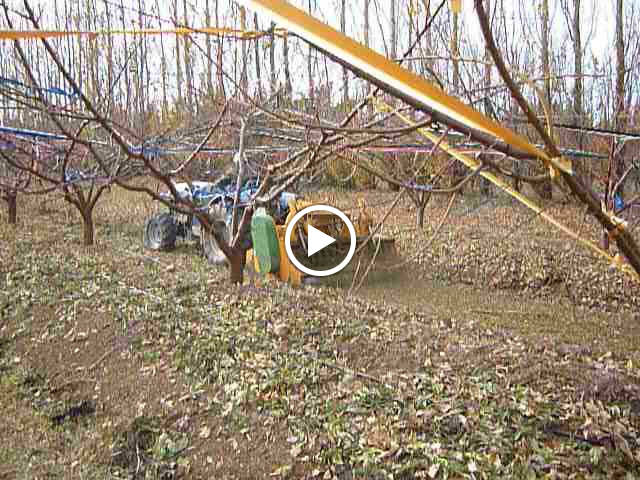
A tractor equipped with a mill, it is the most common way to take advantage of pruning in summer and winter. 

Burning should be reserved for very unusual cases of severe disease problems, since it is a direct waste, with polluting effects, accompanied by the destruction by fire and heat, of surface soil life. Many farmers are very reluctant to let the crushed wood, for fear of spreading disease. Yet it must indicate that there is an alternative to burning, composting, since, in its natural process, the temperature can reach 70 degrees for many hours, which is an excellent sterilizing agent that eliminates bacteria, fungi, insects, and even weed seeds.


Grinding is the most effective way to combine the needs of agriculture (to walk and move in the orchard), with the natural behavior of wood cycle in a forest. It is a process, using a very fashionable word, totally sustainable.
If the case of extracting or burning the pruning wood, it is necessary to compensate for these extractions by fertilizer inputs. Yet fertilizers without organic matter (chemical or biological) only compensate the extraction of elements, but are not able to maintain the activity of soil life. Gradually, the soil loses its structure and fertility. The crop conditions are always more difficult, and productive results get worse. It is necessary to bring organic matter in one way or another, for example as compost or composted manure.
Extractions of nutrients that represents one crop are generally quite limited, and easily offset by moderate fertilization. If we add the extraction of wood, they are much higher amounts. It is here that appears the real risk of destroying the soil structure, of loss of fertility, and of environmental pollution, because of the amount of fertilizer to be brought.
 

After the winter pruning, walk or move can be a problem.

Maintain or enrich the soil with organic matter has significant agronomic benefits:

-      -   The soil life is much more important and active, which promotes fertility, aeration and its ability to store water from rain or irrigation.
-      -   Organic matter plays a fundamental role in the clay-humic complex, that is to say on the exchange capacity of nutrients to the plant. The efficacy of the plant nutrition directly depends on it.
-      -   In orchards, and combined with ground vegetal cover, that is to say, with the presence of grass between the rows of trees, this technique promotes the proliferation of earthworms, promotes the drainage and reduces compaction.
-       -  In many cases, the most visual benefit is an increase in the uniformity of the crops, which results in an increased productivity without the need to increase the contributions of fertilizer or irrigation water. Natural irregularities in the texture of the soil, combined with the work of the farmer, make that a plantation, initially homogeneous, becomes heterogeneous with time, with powerful and productive trees, and others weaker and unproductive. Win in homogeneity is to ensure that the trees are all powerful and productive.

There is no longer a problem.

The environmental benefits of proper management of organic matter are even more numerous:
-       -  A significant active soil life promotes biodiversity. For example, increased earthworm populations promote moles and birds populations that feed on them, which promotes the proliferation of snakes and predatory birds, and so on.
-      -   Increasing the natural fertility of the soil reduces fertilizer consumption, since much of the crop needs are naturally provided by the soil itself.
-       -  The improvement of soil aeration allows better penetration of rainwater, and a reduction in irrigation requirements.
-       -   The improvement of soil aeration also allows better drainage, thereby reducing the risk of asphyxiation of crops, as well as rain water losses by surface flow, and improves refill possibilities of groundwater.
-       -  As in the case of no-tillage technique for annual crops, keeping the soil without plowing, with remaining pruning wood grinded on it, especially if it is combined with green cover, greatly reduces loss agricultural soil erosion due to rain or wind.
-       -  The improvement of the homogeneity of crop plots allows for better productivity. At the local level, it's a higher income for the farmer. At the global level, it is a guarantee to continue to grow in productivity, that is to say, to produce more, with no need to conquer new lands, to cope with the increase in world population. This is an obvious environmental benefit, although difficult to assess locally.
-      -   No-tillage significantly reduced the release of CO2 to the atmosphere, which is directly involved in combating global warming.
-       -  There is a fact little known to farmers themselves, but potentially very important, which is the improvement of the ability of the plant to self-defense because of the richness of soil in beneficial microorganisms. This point requires an entire post on its own.
-       -  Finally, there is evidence that a more active microbial soil life greatly improves its ability to break down pesticide residues, chemical and biological, reducing the risk of groundwater pollution.

In the following spring, the grass has grown and we no longer see the wood prunings. Yet they are on the ground.

Grinding the pruning wood for its return to the ground is a totally sustainable practice as it actively participates in maintaining soil fertility, in its conservation, in its drainage capacity and its ability to produce, in the long term, important crops in quantity and quality. In the case of degraded soils or very poor in organic matter, external inputs like compost are needed to make them a sufficient workforce. It is a long process that can take several years.
But be careful, to be effective, an organic matter enrichment has to be made in very large quantities. An example :
To increase the percentage of organic matter 1%, in the 30 first centimeters from the ground surface, it has to be taken into account that 30 centimeters of soil are 300 liters per square meter of soil, or 450 kilos, and that a compost generally contains around 40% of organic matter.
So for a garden of 100 m2, it will bring more than 1 ton of good quality compost and a farmer will have to provide more than 100 tons per hectare.
This short calculation is intended to make you understand that the annual return of plant remains is an easy technical, economical and very effective way to keep soil in good conditions. It is interesting, especially for the gardener, to do his own compost with all plant remains he generates, for example, from decorative plants, hedge trimming, damaged fruit and vegetable, scraps or peelings, or cut grass. It's easy, it does not smell bad and it is an excellent nutritional supplement. It only requires to be returned from time to time, and to be kept moist. I want to write a post about compost.
This calculation is also a warning that the usual organic fertilizers are misleading. It is a good source of nutrition, but not a soil enrichment. For that, it would bring in huge quantities.

At the end of a very dry summer, the grass has dried, mixed with the crushed remains of pruning, forming a thick layer of organic material, ready to be decomposed when arrive the first autumn rains. The grass will sprout again, and next spring, we will have new green ground cover, fine and very active.

Without plants, there would be no life on Earth, but without fertile soils, plants could not grow.
The soil is plants life, so that of humans. More simply, the soil is life. We must take care of it, as if we are farmers, gardener, or single owner of a garden.
To care of it, we must first know it, and understand the complex processes permanently taking place under our feet, and in silence. We don't care of it. Yet our life depends on it.