One
of my contacts from LinkedIn, Gildas Guibert, technical manager of a major
French fruit production company, and very active on the networks, recently
launched a survey among members of his French-speaking network.
Published
answers made me want to know what the reactions of my network to this question
are.
My
network being more international, I decided, with his agreement, to resume this
survey but modifying the question.
Picture of my own
So
here it is:
When you buy unprocessed food
(fruits, vegetables, cereals, eggs, meat, milk, etc.), what is most important
to you?
1-The
price?
This is the consumer price.
2-The
taste?
Depending on the products, we will talk about flavors, sugar, crunchiness,
juiciness, etc.
3-The
aspect?
Depending on the products, it may be color, brightness, freshness, appearance
defects, etc.
4-The
origin?
Local, national, close import or far import.
5-The
mode of production?
Environmentally friendly production (organic farming, integrated production,
conservation agriculture), or conventional production, small farmers or large
farms, etc.
On
the other hand, as I believe your response will be influenced by your relationship to agriculture, I
would like you to indicate it in the following way:
A-Direct
relationship to agriculture
(farmer, or packer of agricultural products, agricultural worker or working in
agricultural product packing, agricultural adviser, farmer's child, etc.)
B-Indirect
relationship to agriculture
(manufacturer or seller of agricultural inputs or equipment, service provider
to agriculture, such as insurance or new technology services for example)
C-With
no relationship to agriculture.
And
finally, tell me your country of origin.
I believe that the culture of each country may have an influence on food
education.
Your
answer could be, for example:
5, 4, 3, 2, 1, B, India
Of
course, comments are optional, but welcome.
Indicate
your answers preferably as a comment directly on the blog, it will be easier
for me not to lose any answer.
I count on you. Share on your
networks,
we will have more answers. It will probably take me a while to analyze
everything, but I am sure that we will learn some very interesting lessons.
An
interesting article published in May on the Spanish blog "El ecologista
transgénico" (The transgenic ecologist) informs us about the perception of
risk by the public, and warns us against the enormous media pressure that we
suffer daily, with the sometimes mistaken perception of certain topics.
I'm very
interested in this article because agriculture, and in particular pesticides,
are among the targets most frequently affected by this problem, very often in
an unjustified way.
Mistakes in the perception of risk
are the basis of many problems in the communication of science, so I will
dedicate this article to this topic, trying to clarify concepts through several
examples. Because every day, in our daily life, we must take an infinity of
decisions which are an exercise of balance between benefits and risks, some
unconscious, others more reasoned. Unfortunately humans are not very good at
assessing these risks. It greatly complicates our ability to make consistent
decisions, from medical decisions, more or less important, to the choice of
food we bring to our mouths.
In fact the evidence is clear, we
can't avoid these mistakes. Our apparent irrationality on these points is the
result of innate processes that operate outside of our conscious control. There
have been identified a number of emotional "fear factors" that make
some potential threats more fearful than others, unrelated to the obvious:
-Risks
created by man scare us more than natural risks.
It is therefore likely that we are more frightened by transgenic crops,
radiation from nuclear power plants or chemical plants, than by
"natural" risks such as unpasteurized milk, natural medicines or
carcinogenic radiation from the sun.
-We
are more concerned about risks we can't control and we tend to underestimate
risks we can control. For example we
overestimate the risk of glyphosate (or other phytosanitary products) but we
underestimate the risk of not eating enough fruits or vegetables, or sedentary
lifestyle.
-Imposed
risks make us more afraid than those we voluntarily take.
For this reason, the perception of risk is greater in the case of radiation
from nuclear power plants than in the case of sun radiation, to which we
voluntarily expose ourselves.
-We
are bad at assessing long-term risks and benefits.
We have an innate tendency to focus on the short term. For example, when
diseases such as measles or mumps disappear, the benefits of vaccination that
helped overcome them are no longer evident and can be questioned.
-We
often forget to consider the risk of doing nothing, or the alternative.
These mental shortcuts and our
desire for simple answers about causality, risk, and benefit, lead to some
common mistakes in the way we act in our own lives.
Danger and
risk
Danger and risk are two different
but related concepts.
A danger is an agent that has the
potential to cause harm.
Risk measures the probability of
harm by a danger.
Dangers become risks only if there
is an exposition to it. Example: solar radiation is a danger. But if I never
expose myself (or protect myself) to radiation, I will not face the risk of
burns or melanomas, although the danger exists. Despite this difference, we
tend to consider all dangers as risks, regardless of our level of exposure.
This phenomenon is very evident in
the classification of IARC carcinogens (IARC http://monographs.iarc.fr/ENG/Classification/).
Danger identification is the first step
of the risk assessment, but it is not, in itself, a risk assessment, yet we
constantly see hazard identification studies presented as evidence of real
risks. These classifications are based on the strength of evidence and not on
the degree of risk. Two risk factors could be included in the same category,
although one increases the risk of cancer threefold and the other only
increases it by a small fraction. A good example could be tobacco and processed
meat, both included in category 1. According to Cancer Research UK (http://scienceblog.cancerresearchuk.org/2015/10/26/processed-meat-and-cancer-what-you
-need-to-know /), smoking causes 19% of all cancers. On the contrary, it is
estimated that "only" 3% of all cancers are caused by processed meat
and red meats combined. As a result, evidence that processed meat causes cancer
is as strong as that of tobacco, but the risk of tobacco is much higher.
All dangers
are not equal
As we have seen, not all dangers
are equal, they can affect a distinct number of people and be more or less
damaging. By observing the graph, we divide hazards into four categories based
on the number of people affected and the severity of the damage. The nature of
the product (natural or synthetic) has nothing to do with its dangerousness.
However, we sometimes tend to
consider that all dangers we pay attention to are as damaging as each other.
The development of the anti-vaccination movement shows this tendency to see all
risks as equal (considering the dangers of vaccination and the dangers of
diseases as equivalents in both gravity and risk of problem). The diseases that
are prevented by vaccination belong to the upper right-hand panel of the graph.
Vaccinations move the danger of these diseases to the left upper cadre by
significantly reducing the number of people affected by these diseases. On the
other hand, the vaccines themselves possess a generally low danger on a limited
segment of the population, which places them in the lower left-hand frame. Yet,
in many people's minds, the extremely rare risks (real or imagined) associated
with vaccines have become equal to or greater than the (real) risks of catching
the disease. The problem is the same for food additives.
Conclusion
We are permanently exposed to a
large number of dangers, some of which may pose a risk to our health if we
expose ourselves to them, if they are in excessive concentration or if they are
too frequent. Errors in the perception of risk are the basis of many problems
in the social communication of science. These errors are partly due to our poor
ability to correctly assess these risks (they can also be intentional). To
avoid them, we must evaluate each hazard separately, analyzing its damage
potential and level of exposure, as well as possible alternatives or the
consequences of avoiding it, to find out if something really represents a risk.
The confusion created around the
difference between danger and risk is carefully maintained, with a desired
objective, usually hidden, intended to favor sales or to provoke a change of
opinion or behavior.
This is
undoubtedly what has been happening for several years against conventional
agriculture, to promote the consumption of organic products. Those who
communicate in this way are capitalist companies that distribute organic food,
or environmental NGOs that try to attract new members, or to increase their
power.
This market
is very lucrative, and the means used to develop it don't hesitate to denigrate
everything that stands in its way.
Attracting the consumer by playing
on his fears is the only thing that matters.
And the collateral damage caused,
which is sometimes serious, does not matter.
This
is probably one of the least important factors for the consumer, but it's
fundamental for the entire chain that will drive the food from the farm to his
table.
Among
the agricultural products, the most affected by this point are fruits and
vegetables.
Packaging
actually has many roles, all important for someone, all binding for the farmer.
This
is the first challenge that the food must undergo when it leaves the field. It
is sorted according to several criteria which are in general its size (one
speaks of calibration, often standardized), its color (according to criteria
established for each product, sometimes variable according to the destination),
its visual quality (aspect, esthetics, respect of standards) and its state of
maturity (insufficient, timely, too advanced) or freshness.
Personal
video: nectarine packing
These
criteria will decide the classification of the product in first choice (or
extra, for those who still practice it), second choice, sometimes third choice,
industry (transformation into juice, concentrate, puree, or cutting for
different uses in the food industry and the preparation of cooked dishes), or
trash.
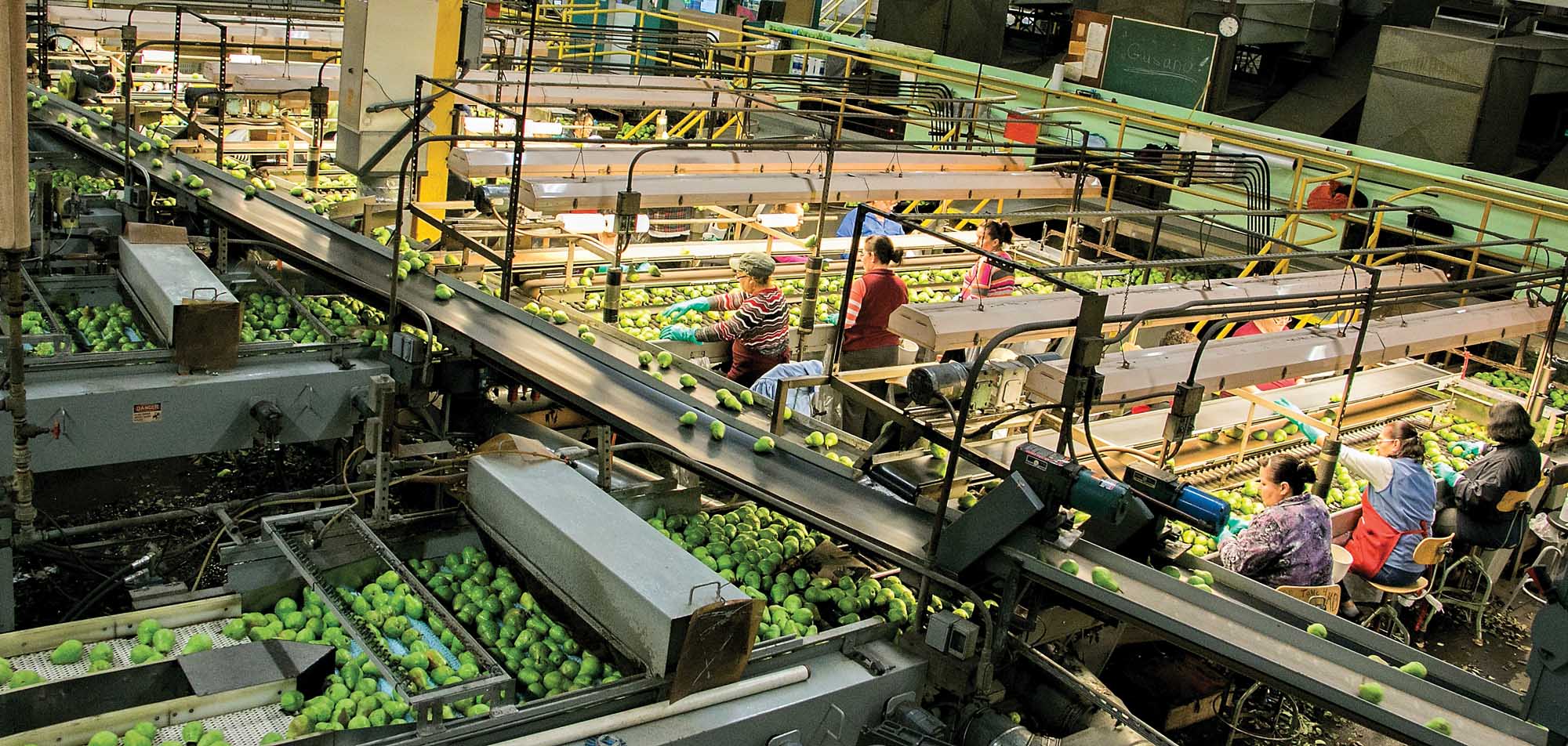
This
work is carried out in the packing house, in an increasingly industrialized way
in order to reduce costs and centralize ever larger volumes.
Each
packing station has its own working capacity, adapted to the group of farmers
who bring its production, and to the different products concerned (it's obvious
that we won't prepare melon like cherry or lettuce like carrot).
The
sorting is generally done by a machine, more or less sophisticated, with
assistance by people to refine the quality selection, according to criteria set
for each batch, particularly with regard to the sorting of visual defects.
More
and more seldom in rich countries, and still frequently in developing
countries, selection can be done entirely by hand, but generally following the
same quality criteria.
The
farmer must do everything possible to maximize the classification in first
choice, which will be much better paid for him than the lower categories. The
industry and the bin don't usually cover even the cost of harvest.
The container
Once
selected, the food will be placed in a container, a packaging, which
corresponds to the requirements of the client. The diversity of formats is a
real headache for the packing house.
There
are boxes of different sizes in cardboard, compacted cardboard, wood, reusable
or disposable plastic, trays (different sizes, different colors, with or
without cover, with or without film, with or without net, with or without
handle), the cells (paper, cardboard, plastic, in all sizes), etc.
For each client, requirements may be different, with their own brands,
or the brands of the producer. In addition, the same customer can change its
formats from one year to another, making the remaining stock of the previous
year obsolete and unusable.
But the station has to manage an extremely complex stock, and expensive,
because the orders are generally carried out day by day, forcing it to
permanently have a volume of each type of packaging allowing it to respond
immediately.
For us here in Seville, if a client from Frankfort places an order for
us on a truck on Monday, we have time to prepare it and send it to him. But if
we don't have the necessary packaging in stock, we don't have enough time to
order them, and we lose the sale. Because the truck must arrive on Monday as
planned. No delay is acceptable. And we must also count with the French ban on
truck traffic on Sundays and public holidays.
The container obviously has a great marketing importance, but it's also,
depending on the case, a protection or a constraint.
Personal photo
A box with its cell protects the product, prevents it from moving and
being manhandled during transport, and helps maintain the quality of the
product until sale.
On the other hand the tray, according to the products which it contains,
can become a negative constraint for the quality. This is true for large
products, not for small products, such as cherry tomatoes, raspberries,
blueberries, cherries, etc. In the case of peaches and nectarines, the tray
requires to put a very firm fruit, even hard. It's the opposite of quality.
Personal photo
But some clients, or some markets (more and more numerous) only want
this format, much more convenient for the sale to the consumer (no
manipulation, no weighing, the price is pre-established). The fruit is then
transformed into a totally industrial product, and the satisfaction of the end
customer no longer matters.
The type of packaging is of extreme importance for the marketing
channel. Yet, in many cases, after a difficult, delicate and expensive
packaging work, products are then presented to the consumer in bulk, out of
their expensive packaging!
It may seem trivial, but it is essential. The label contains all the
necessary legal information (country of origin, packing company, product
characteristics, quality, size). Some customers require that their own brand
appear, and even that is printed bar code that will be used in stores.
These labels are printed in the packing station itself. A room will be
empowered for this, with the necessary printers and all the stock of the
different formats of labels, sticks and other added items.
No printing defects are tolerable.
Once, it happened to us to see a large batch refused in destination for
a defect of the printer, barely detectable with the naked eye: the bar code was
not readable for the machines. All the work was perfect, but the label was not
usable in store. For the client, this is a real problem, since he has
eliminated the need to label himself, so he is not equipped to make up for a
labeling error.
Personal photo
For
the packing station, an error of this type can be extremely expensive. It has
little choice. In fact, we had to modify our control protocols as a result of
this incident.
Either
it sends someone on the spot with the corrected labels, but it does not have
the option to meet deadlines any more. The product is not suitable to be sold
within the agreed time.
Either
it tries to sell it to someone else, but it's difficult with packaging and
labeling intended for a concrete client. Ultimately, it will be solved anyway,
usually by a significant discount on the selling price to the station (then
usually passed on to the farmer), which will probably not be applied to the
consumer.
In
short, labeling is an important point that does not support approximation, let
alone error.
And the quality in all this?
In
fact, we only talk about that.
But
the product itself hardly counts. As long as it meets the minimum requirements
(size, appearance, sugar, juiciness, color, firmness, freshness, etc.),
packaging becomes more important.
The
quality of the packaging depends on the entire process of transport, handling,
storage and preservation that will drive the product from the field to the
shelves to be sold to the consumer.
The
food production is gradually losing its soul under the increasingly tough blows
of markets.
When
I arrived here, the clients came to visit our orchards, to taste fruits on the
tree, to appreciate in the field the quality of the realized work.
Today
the client, if he comes (which is more and more rare), is more interested in
packaging, traceability and hygiene, than in the product itself.
He
verifies that specifications are respected, that hygiene and safety processes
are adequate, and that analyzes (bacteriological and residues) are in
conformity.
The
product is now defined by numbers, analyzes, test results, accreditations,
traceability.
The
product is now defined, for the satisfaction it gives, only by sales figures,
and on cooking TV programs.
Food
production is slowly pandering to the market demands, which are trying to
convert it into an industrial process like any other, in which everything is
predictable and predicted, especially with regard to quality.
Quality
is present, but in criteria often difficult to perceive and understand for the
consumer.
And
it's not the arrival of Amazon in the food market that will improve that.
The
farmer has to comply with the requirements of the markets, and only those who
can sell on short circuits have the opportunity to value a taste quality, often
associated with a level of maturity that requires almost immediate consumption.
As regards consumer, he wants to enjoy the
food, and still dreams of finding "the flavors of yesteryear", even
in supermarkets, which are less and less able to offer them.
These are two very different conceptions for the same product, which
further increase the growing incomprehension between the rural and the urban
world.
It was to be
expected. The organic begins to run up against the cancer of fresh products:
the appearance. I told you about this a few months ago, explaining that this is
probably the first criterion of quality, since its influence is direct, both on
the purchase gesture and on the purchase price for the consumer, as well as on
the price the farmer will receive for his production.
Until
now, organic farming has escaped this problem which is generating an impressive
amount of food waste. The classification of organic products does not follow
the same requirements as conventional products.
In organic,
rubbing damages, a large part of deformations, even heterogeneities of caliber
in the same batch are tolerated. There is no first and second choice in
organic. Normalization has not yet stuck its nose there.
This
difference has long been a source of tension between organic and conventional
growers, since most of these aspect defects have nothing to do with the method
of production. They can be due to wind, hail, cold, pollination problems, bird
strikes, and a host of other causes that can't be chemically controlled.
In
short, this difference in criterion is purely political, intended to favor
organic farming compared to conventional agriculture.
Historically,
the difference in productivity between organic and conventional, evident in
most crops, although not systematic, was largely offset by these differences in
commercial criteria, allowing the organic to obtain a comparable quantity sold
per hectare, thanks to a lower percentage of waste.
However,
this commonly accepted rule, although without any justification in terms of
taste quality, is beginning to lose its lustre. The year 2017 is a black year
for many productions, mainly for serious commercial problems, great
difficulties to sell, and generally very low selling prices, often lower for
the farmer to his costs of production.
And what
happens when the market is in this situation?
It is
becoming more and more demanding on quality.
And now
organic agriculture is beginning to face one of the main difficulties of
conventional agriculture.
So, look at
the case of these small organic farmers, despairing of a situation, altogether
quite habitual, but to which they are not prepared:
"A couple of farmers are preparing to
let nearly three tons of zucchini rot, due to consumer demands.
Would a stain on a zucchini prevent
you from buying it? This is in any case the reason for the mess of a large part
of the production of a couple of organic farmers. Due to slight defects on
their vegetables, Caroline and Cyril Roux are forced to watch their hard work
rotting, due to consumer demands. "
Yes,
I understand their state of mind, it is hard to accept.
Do
you know, for example, that when I prepare my harvest forecasts, several months
or weeks before I start, for the orchards for which I have responsibility, I
introduce a value of 15% waste?
Yes, 15% of
fruits not marketed, thrown in the trash mainly because of aspect defects.
And still,
15% is not too bad. This year, because of the difficult trading conditions,
this percentage has risen to 20%, and last year, exceptionally difficult
climatic year, we have almost reached 25%.
Every week during the harvest, dozens of tons of peaches and nectarines await trucks for industrial uses, a modern and profitable form (except for the farmer) to avoid simple destruction. They will be processed into juice, puree or concentrate. The only other option is the garbage. These fruits do not correspond to the commercial standard, mainly for aesthetic reasons (epidermis defects).
In my
precocious, short cycle conditions, with specific varieties, which are
generally not very productive, but adapted to the local climate, this means
that for my peach or nectarine production, I know before starting that about
4,000 kilos of fruit per hectare will be trashed each year, and if I come
across a tough year for any reason, that figure can exceed 6,000 kilos.
As these
farmers say,
"These little green spots on
zucchini were caused by the high temperatures of June. However, they don't
alter the taste or quality of the vegetables. "Many want perfect
organic" »
This is an
inevitable evolution of the organic. This is one of the consequences of its
success, its popularization.
More organic
production, it's also the access to the organic of a wider, unprepared,
uninformed public, who buys organic just because he thinks it's better without
really thinking about the scope of this change.
As besides,
it's a constantly growing market, it's a huge source of wealth for many people
(see for example Biocoop or Kokopelli, unscrupulous businesses, fully
exploiting a juicy vein), all means are allowed to attract new consumers, and
disinformation is a great way to get there.
Many
consumers are converting to organic, frightened by the nonsense that are told
to them or by health scandals, for which there are only highlights on what
interests ...
The big
capitalists of organic are succeeding their bet: people are worried about the
quality of their diet. For the planet, too, of course. But it's above all an
individual gesture.
And
people who convert to the consumption of organic products directly transpose
their habits and requirements of consumers of standardized conventional
products, on organic products.
The circle
is going to complete. Consumers will force organic production to increase
quality criteria, at least in terms of appearance.
An
ever-increasing share of organic production is sold in supermarkets, without
supervision or advice, and consumers buy at sight, so at appearance.
And what
makes one of the main attractions of organic farming, from the farmer's point
of view, the economic margin per hectare, is melting away.
Because an
organic grower produces less, but sells a greater part of his production, and
at a better average price ... so far.
It's
changing.
Will this
problem only be a bump in the organic road, the (too) rapid and (relatively)
out-of-control development of this mode of production? It is possible, in the
short term.
But
don't doubt it, sooner or later, we will get there.
What I
explained to you a few months ago about the appearance: an increasingly
important part of organic phytosanitary interventions will have a cosmetic
objective.
Products
will be organic, of course, but they will have much greater side effects.
For when a
farmer knows that at least 15% of his harvest will be unsaleable, he does
everything in his power to control everything he can control, in order to limit
aspect defects to the maximum of his possibilities, therefore attacks of
insects, bacteria, fungi (light damages are theoretically accepted in organic,
but not in conventional).
So
he will use an increasing amount of insecticides and fungicides, organic but
not free of undesired side-effects.
And the
respect for the environment, in all this?
It's a wish,
a willingness, or a requirement of people who have the means to demand it, or
the ignorance that does not allow them to know that these small defects of
epidermis don't affect the quality of the most of the products, neither organic
nor conventional.
And these
same people, who "want perfect organic", are also often the same who
are scandalized by food waste, or by negative effects of agriculture on the
environment.
Because
these requirements inevitably lead the farmer to implement agronomically
unnecessary but economically indispensable practices.
Individual
logic is often incompatible with community logic.
How to
resolve this?
Probably by
undistorted information, without ideology or commercial undertones, and by the
education of the consumer.
The
farmer can do some things, and in fact, blogs, objective (non-sensational)
agricultural information programs and open days on the farm are multiplying in
Western countries.
But
the substantive work is not within the reach of the farmer, it should rather be
the role of civil society, and therefore of public administration.
A man can
dream, can't he?
In France,
the "General States of Food" are currently held, a major consultation
at the national level, concerning all stakeholders in the sector. This is an
election promise of new President Macron.
It could
give birth to a mouse, or put up so many brakes and constraints that farmers
would become landscape gardeners.
It should be
said that in France, one of the G8 countries (one of the most modern and
richest countries in the world), one farmer out of two earned less than 350 €
per month (around $ 400) in 2016. This sum does not say anything if it is not
related to the SMIC (interprofessional minimum wage) which was in 2016 of 1143
€ per month, all expenses deducted. In other words, one farmer out of two earns
three times less than his own employees, or that what the national authorities
consider today as the minimum to live decently in France!
And you
would these people to be preoccupied with things that are quite abstract after
all, when they struggle every day to make their businesses survive and to offer
their families acceptable living and education conditions?
Some found
in organic farming a dignified and elegant escape, economically interesting,
and intellectually and socially rewarding.